How to survive as a marketer with limited engineering resources
Have you ever struggled to fulfil your marketing objectives due to limited support from your Engineering team?
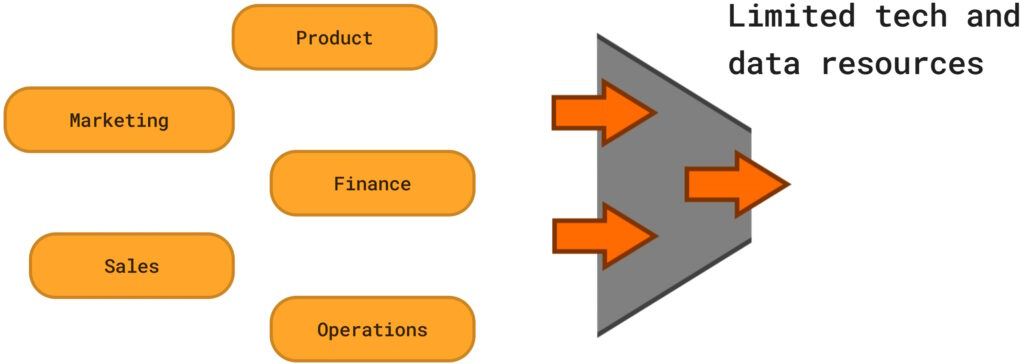
I’m willing to bet every Marketer has had some frustration implementing their ideas when competing for scarce developer hours with Operations, Sales, Finance and other business teams.
I can speak from personal experience. In past companies, I’ve dutifully prepared my product requests, prioritised them internally with other marketing stakeholders and relayed them to the Product Manager – only to be told that no marketing tasks would be picked up this quarter. Frustrating.
Not pointing any fingers at our Engineering friends, of course. They have their own set of challenges – with recruitment near the top of the list.
However, when tech resource issues bite, marketing requests are often the first on the chopping block. Ultimately, no matter how much marketing might hate it, an urgent task from Operations around say, customer payments, is very likely to bump any marketing tickets.
_Digital marketing is getting more complicated__
The Digital Marketing landscape is becoming more sophisticated, meaning the need for technical support is greater than before.
As an example: Customer Data Platforms (CDPs) are often sold as marketing enablement tools to reduce dependence on Engineering teams. However, they involve significant tech investment to set up and maintain. Even configuration tasks require a decent technical understanding, which may not be available within every Marketing team.
And on the subject of marketing complexities, a brief word on the elephant in the room: privacy initiatives from Apple and Google.
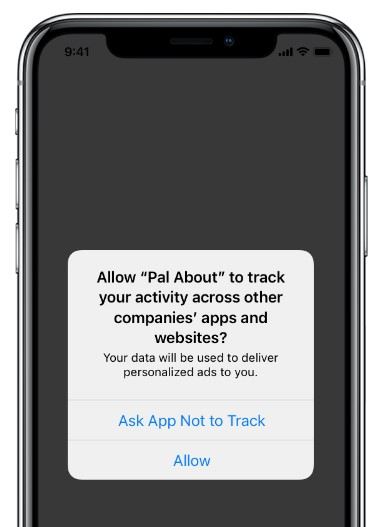
In 2021, iOS 14.5 saw the introduction of App Tracking Transparency (ATT) and the requirement to get consent to use the advertising ID – bringing to an end the era of ‘easy’ attribution and data-driven marketing.
Even though it’s possible to get a very good consent rate (>50%), you will need support from Engineering to call the system prompt and someone in Marketing with testing expertise in order to optimise.
The ‘privacy safe’ alternatives can be tricky to grasp.
Apple’s SKAdnetwork requires an in-depth understanding of a company’s funnel and revenue drivers in order to set up the conversion values. Google’s Privacy Sandbox will likely call for similar skills.
Anyway, enough background. It’s clear that Marketers need engineering resources! So how about the key question: How can Marketers cope with limited support from their technology teams?
_Coping with limited Engineering resources__
Considering a typical marketing team’s technical requirements, you can normally break things down into two broad buckets:
>>
Updates involving core company engineering infrastructure i.e. mobile and web apps, data warehouse, backend
Examples:
- Setting up new tools requiring integrations with the apps e.g. new CRM platform including a mobile app SDK
- Implementing ATT framework on iOS
- Reverse ETL process from the data warehouse to enrich a marketing tool with first party data for personalisation/segmentation
- Setting up promocodes or bonus programs (if an automated way has not already been provided)
>>
Coding or configuration tasks on marketing tools or other existing infrastructure accessible to Marketing
Examples:
- Designing & coding email templates or building landing pages
- Writing automation scripts to run in a CDP, or acquisition tools like Google Ads
- Setting up new conversion events in a tag management tool
- Pulling data from data warehouse for analysis
For the first set of tasks, you will normally need the support of your Engineering team or dedicated developers working within your company’s engineering processes. However, for the 2nd group, this is not the case.
When it comes to providing solutions for the ‘limited tech resources’ conundrum, in my experience Marketers should approach the issue from 2 angles:

1. Increase the level of technical expertise in the Marketing team

2. Make Engineering requests as actionable as possible to maximise the efficiency of the support hours available
Let’s go through those 2 points in more detail!
_Increase the level of technical expertise in the marketing team__
Easy to say. Not so easy to do. Here are some thoughts:
1. Hire a developer
The obvious one. Berlin tech giants like Delivery Hero can afford to have an entire team of developers, data engineers and analysts dedicated to marketing requests.
Before you start drafting a job description however, a word of warning: simply hiring a developer isn’t going to work (I can speak from personal experience here). Amongst other things, your devs will need access to the company’s infrastructure, interesting/challenging tasks to work on and a peer support network with other engineers for code reviews etc.
Whilst a “marketing engineering” team guarantees your requests will be prioritised, setting one up requires significant effort and is not realistic for most companies.
2. Set up a Martech team
Hiring technically-minded marketers is also a reliable way to boost your expertise; with the added bonus that they can slot nicely into your existing team.
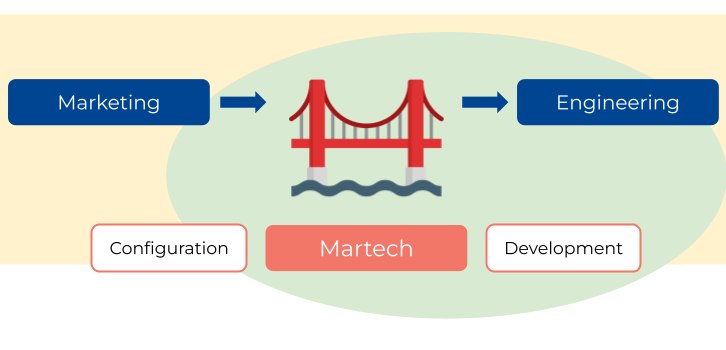
Martech will be your bridge between marketing and engineering, drive technical innovation, manage your tools & integrations – basically take on the “coding and configuration tasks” listed in the concept section above.
The exact composition of the team will depend on your technical requirements, but you will probably be looking at analytical profiles and people with hard coding skills, as well as tooling experts.
See this post for more ideas on setting up a Martech team, and this post for ideas on typical tasks that Martech might take on.
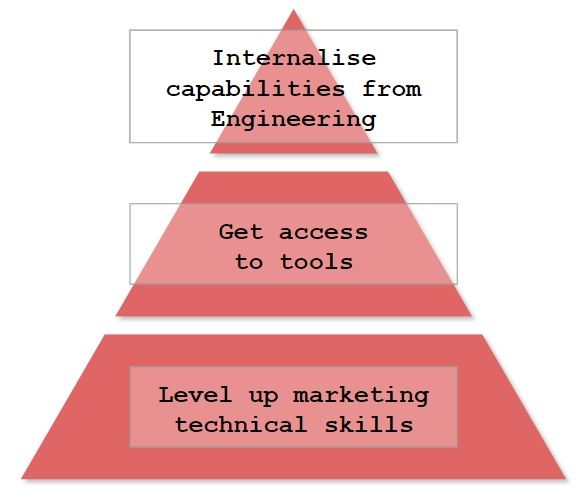
3. Upskill your existing team
Even if you don’t have dedicated technical skill sets in marketing, you might very well have team members with technical aptitudes – or at least an interest in learning.
There are many “classic” ways to learn new technical skills. Platforms like Codeacademy are great for syntax, but in my experience learning goes faster (and will be retained more easily) when you have a meaningful task or project to work on; whether a coding task like producing a responsive email template, or a wider project like redefining an attribution model. In either case, having a distinct objective is going to make for a much more focused learning experience than simply swotting up on theory.
These “meaningful learning tasks” will depend on your team’s broader responsibilities, of course. Make a straightforward gap analysis to help you identify areas for improvements. Assuming you don’t already have technical experts in your team, you should start with simple tasks and build up.
Going back to the responsive email template example introduced above: in the absence of anyone with HTML/CSS knowledge, many teams fall back to drag-and-drop editors, which often output rather confused code and often aren’t very flexible with company-specific branding.
As an alternative, you might ask someone external to your team to build a base template, which your CRM team can then edit. Later, you can nurture those editing skills with online learning platforms like the aforementioned Codeacademy, or take advantage of mentoring programs. Your engineering team might be able to help with mentoring, or you can find external mentors with minimal extra budget.
Ultimately, you will be producing much more attractive emails than before!
A couple more upskilling recommendations:
- Take time to understand the capabilities of the tools you use. Many marketing tools include webhook functionality (outgoing API calls) that enable you to easily share data inside your marketing ecosystem e.g. to share audiences from a CRM tool to a remarketing tool or to build integrated customer journeys without engineering support.
- Make a list of all of your manual, repeated processes and figure out ways to automate them. Google App Scripts is a Javascript based platform and if you use Google Workplace, it’s already part of your tech stack. It allows you to build complex automations without the need for installation or engineering support. I strongly recommend any Marketer with an interest in automation take a look!
4. Get access to more tools and internalise capabilities
Whilst you control your specialist marketing tools (CRM, acquisition platforms, social media), you might not have access to tools touching your company’s core technical infrastructure e.g website, mobile apps, backend.
Naturally some things are best left in the hands of your Dev team! However, there are also things which marketing teams need access to in order to do their jobs effectively.
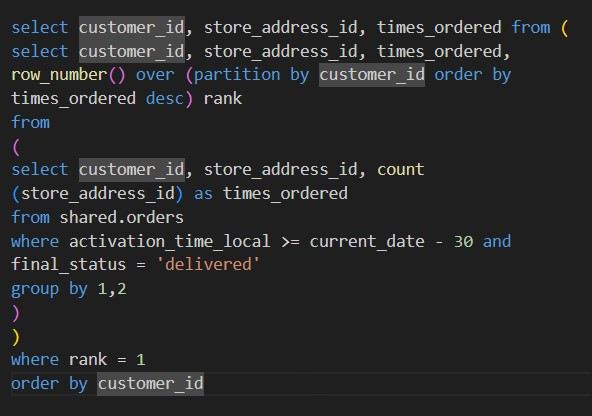
Data warehouse access is one of the first things I ask for when starting a new job. Even if you’re not an SQL expert, a read-only login will help you understand what data your company is collecting and how that could be used to enrich your marketing.
Some tools strongly overlap both marketing and engineering. Tag management platforms like Google Tag Manager and Customer Data Platforms like mParticle and Segment are essentially marketing enablement tools, yet often fall under the engineering teams’ remit. With good reason. When misconfigured, they can significantly disrupt core company processes, result in data breaches, or cause other legal troubles. Your Engineering team may be reluctant to give up too much control, yet access to these tools is essential for internalising capabilities to your marketing team.
Three final points here:
- Internalising technical capabilities is a process, not a single action. Take your time, build up trust, demonstrate your technical knowledge and the most important things by far, keep an open dialog and build a close working relationship with your Engineering team
- Highlight the potential savings in terms of workload. Ultimately, if you can take boring marketing tasks away from them, your Engineering team will be happy
- If you haven’t already done so, make a Github account and ask to be added to your company’s organisation. This will allow you to see the whole codebase and start working out for yourself how things work. This will allow you to be much more precise with your Engineering requests.
_Make your Engineering requests as actionable as possible__
When dealing with limited Engineering resources, it’s essential to maximise the efficiency of the hours you do get!

1. Have a prioritisation process in Marketing
Your company will likely already have a prioritisation process for technical requests, perhaps running on a quarterly or bi-yearly basis. In addition to this, it’s vital to have an internal marketing prioritisation too. Marketing sub-teams (CRM, Paid Acquisition, Organic) will all have their own objectives. However, there may be some overlap between them, as well as some tasks that can be handled internally within marketing – by your martech team, for example.
To this end, it’s a good idea to have one person/team in Marketing responsible for coordinating the requests.
2. Break down your Engineering requests
Unless you work in a very recent startup, your Product/Engineering team will probably have a specific platform and format for making requests. Jira is the most popular tool in this space. Regardless of the process, you need to break down your requests and include as much detail as possible.
One mistake marketers often make is giving Engineering a problem, rather than a solution. With the best will in the world, your Devs are much more likely to pick up a request when it’s easy for them to understand and implement, rather than one which is confusing and requires extensive preparation before they can start coding. Let me clarify by saying that I don’t advocate taking over Product’s responsibilities. However, there are many marketing requests which are comparatively straightforward and don’t require a full-blown product request process.
Some tips:
- Do you research! Describe exactly what your current issue is and suggest a solution(s)
- Give an idea of impact. How much is the current situation costing you in financial terms, lost productivity etc. and how much will your solution save
- Provide links to documentation
3. Prepare for your QA
Final point, but an often neglected one. Make sure you prepare your QA i.e. how you will test your update is working properly. Marketers are experts with the tools they use, whilst Engineers are not (or at least not in the majority of cases) – so you will be best placed to test the request and sign it off.
Don’t skimp on this step! A thorough QA will help you avoid problems later on. And don’t forget to document everything.
_Summing up__
The lack of engineering support can be frustrating and with the growing complexity of Digital Marketing, that support is needed more than ever.
However, by getting more technical skills in your Marketing team, internalising as many capabilities as possible and maximising your use of Engineering time, you will be able to navigate the challenges coming in the next few years.
Good luck!