How will AI impact the marketing job market in the next 10 years?
I recently came across an article with a startling prediction: by the year 2045, AI will have made the majority of the human workforce redundant. You can of course, find just as many viewpoints taking the opposite viewpoint. Namely, AI will simply supplement human labor, acting as a co-pilot rather than a replacement.
Needless to say, it’s not possible to predict the future, especially 20 years out. But it’s still a topic that is eliciting no small amount of work-related anxiety for many in the Marketing industry, and one that I’ve personally discussed a lot over the last few years.
Looking at the topic over a more manageable 10 years, here follows a few thoughts on the key question:
How will AI impact the Marketing job market by 2035? Or to put it more bluntly: Is AI coming for our marketing jobs?
_No juniors means fewer seniors in 10 years__
Back in June 2016, I was working as a CRM Manager in foodpanda, preparing a campaign due to go out the following week in Singapore, for which I needed a new HTML email template. As our regular email/landing page developer was on holidays, my boss asked me to step in. I’d had some experience with HTML/CSS working on a personal blog (it’s still live, if you’re interested ;), but I had’t worked on email templates. As everyone who has created templates from scratch knows, it can be tricky to render correctly on all ESPs (especially Outlook). But always eager to learn, I went away, researched, tested – and eventually shipped a mobile-responsive email template. It was a basic task, sure; but it was the first technical one that started me on the track to a career in Marketing Technology.
In 2026, this story doesn’t happen.
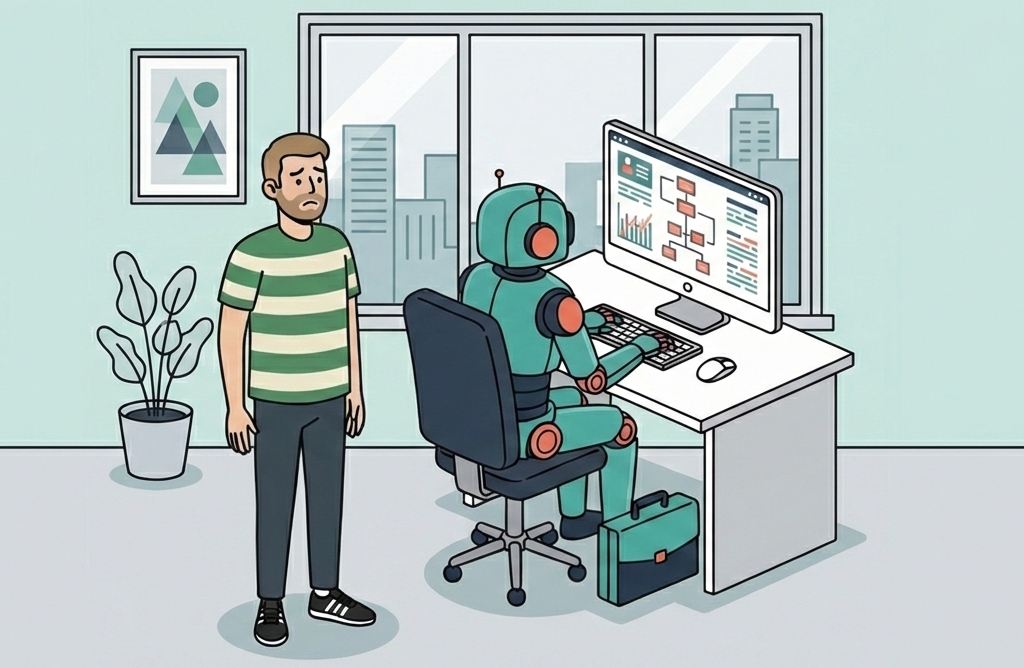
Today, you’d simply prompt an LLM to generate the template in seconds. Whilst efficient, this eliminates an entry point into the industry. These light-ish technical marketing tasks – landing page tweaks, campaign analysis, or tag management – have historically offered the chance for junior people to gain experience, but since AI can handle these tasks more quickly and cheaply, opportunities for humans to learn are becoming scarcer. Studies undertaken in the US seem to confirm this. You can also scan LinkedIn yourself. I’m willing to bet you won’t find too many junior marketing roles.
The knock on effect of this is a looming structural crisis. By automating away the simpler, more repetitive tasks, we are dismantling the pipeline for new talent. This could very well lead to high-demand/low-supply for senior marketers in 10 years or sooner. Unless AI evolves to handle high-level strategy and complex stakeholder management, the industry is headed toward a massive leadership shortage.
_The rise of AI fatigue__
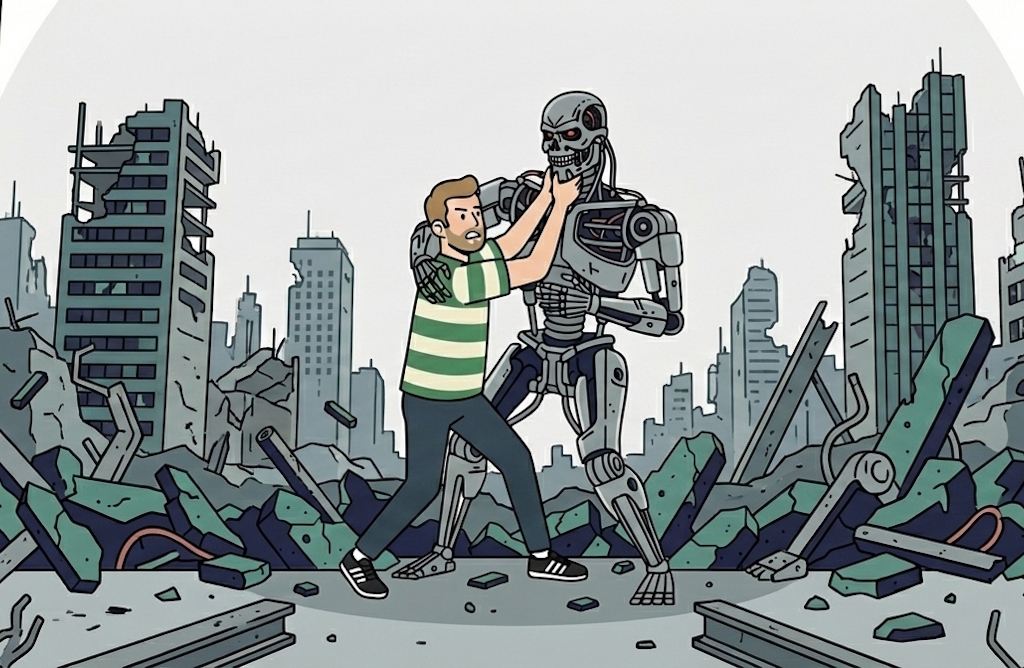
Whilst a heroic struggle against evil AI à la Terminator remains the stuff of fiction, a real human resistance is brewing against the flood of synthetic content.
The impact of AI in marketing is most visible in copywriting and creative production. AI agents, trained on brand guidelines, can pump out variations at a scale which is simply not possible for a human team. For Performance Marketing, the possibility of continuous testing & campaign optimisation is undeniable and exciting.
But quantity doesn’t guarantee quality.
AI might be unbeatable when it comes to execution, but it essentially rehashes old ideas. For truly original content, humans will remain in the driving seat.
The backlash is already visible. Take a gander at any highly viewed Instagram video, scroll down and you’ll find comments calling out the video (rightly or wrongly) as synthetic. AI fatigue is eroding user trust. Companies who rely on AI content may well find themselves branded as ‘fake’, ‘cheap’ or ‘unrelatable’.
In the next 10 years, I think this trend will solidify into a new marketing content reality. In the same way we value hand-produced goods over mass-produced plastic junk, original, human-produced campaigns will become a desirable, high-value asset. Authenticity will become a competitive advantage.
_Reminding ourselves of AI limitations__
Things have moved so fast since generative AI hit the mainstream in 2023, we usually spend our time marvelling at what LLMs can do. It seems like we rarely focus on what they can’t do.
- Lack of strategic input. Many meetings feature AI, but more often than not in the form of a notetaker. Great for recording, but these tools aren’t able to actively contribute to that meeting. They can’t debate, negotiate, or navigate the messy office politics of a strategy session. They can’t sit down with stakeholders, argue for a specific direction, and emerge with a cohesive, agreed-upon plan of action. AI can execute a brief, but it cannot yet decide what that brief should be.
- Potential for hallucinations, false or misjudged content. I’m a fairly confident user of AI, having integrated it into several of our marketing processes at Zenjob. However, I’m still very reluctant to send AI-produced content directly to customers without a human validation step. I’m sure all marketers in Germany remember KFC’s infamous Kristallnacht push from 2022. Even with guardrails, it’s likely that such mistakes will increase if we trust AI to operate autonomously.
- Uneven Implementation Predictions about AI often treat the global economy as a single, unified entity, but the business world is a fragmented collection of separate silos. Implementation comes down to resources. While a multinational with a massive developer team can integrate AI agents overnight, a smaller company might not do so for years. German residents will note that many organisations, especially in the public sector are still running on 90’s era levels of digitialisation. The AI revolution won’t be uniform; it will be a staggered rollout that leaves plenty of room for human-centric operations in the gaps.
_How governments respond __
Around 40% of people in Europe – including us Digital Marketers – work in sit-down professions. In the short-term, this is the group most vulnerable from the march of AI-driven automation. I tend to think large-scale job losses in this sector are unlikely for the reasons outline above. However, if such a thing does come to pass, the impact will be significant: reduced tax revenue, crashing welfare system, diminished spending power and all the secondary effects of those – unbridled inequality, increased crime and possibly the breakdown of liberal democracy itself.
Faced with such a bleak outlook, world governments will have to act. The EU has already shown itself willing to clip the wings of big tech to protect its citizens, with the Digital Markets Act (DMA) and the recent AI Act prime examples. Public opinion will be the catalyst. If workers feel their livelihoods are under threat, the mounting political pressure will leave governments with no choice but to legislate and put limits on to what extent AI can replace human workers.
That’s not to say all governments and trade blocs will immediately follow suit. Other global powers like China and the US tend to allow big business a freer hand; meaning EU companies would be at a competitive disadvantage. Let’s not forget however, that EU companies already operate in a tighter regulated environment and still manage to thrive. If Europe becomes a “safe haven” for human talent and ethical implementation, it might just attract the very minds that AI can never truly replace.
_Summing up __
We don’t need to wait til 2045 to see the impact of AI. It’s already here. By automating repetitive and formulaic tasks, we are altering the career ladder and restricting the opportunities for junior talent to gain experience.
In many ways, the march towards greater automation is a continuation of the trend of the previous 20 years. In 2006, sending a bulk marketing email required data support, manual CSV exports and fiddling with user- (un)friendly interaces. Then came platforms like Braze, allowing us to automate complex lifecycles based on real-time events.
AI feels different. While previous automation advances were incremental, the leap in capabilities over the last three years has been exponential, making it easy to feel overwhelmed—and to fear for our livelihoods.
However, step back for a moment and recognise where the limits of AI lie. It excels at execution, but it cannot yet hammer out a strategy with stakeholders, ideating original campaigns to test, understanding user desires, or navigate the human nuances of “what comes next”. From my perspective at least, AI is still a long way off addressing these points.
AI will undoubtably have a significant impact on the Marketing job market by 2035. But I don’t think we will see large-scale job losses. Rather, I expect our roles to shift in scope. AI will handle the execution, and humans will be the architects.