The challenge of accuracy in fast-moving environments: keeping your content fresh
In contrast to the often glacial pace of product development at large enterprises, startups and scale-ups roll out changes faster than you can say “prototype”. The fail fast environment is attractive to many of us because it offers opportunities to ideate, experiment, and learn quickly — rather than being stuck in the project planning phase for months on end.
But this speed also creates challenges for marketers, who are usually responsible for communicating product changes to end users. Digital marketers often manage hundreds of campaigns, and when products evolve rapidly, keeping content accurate and relevant becomes both time-consuming and error-prone. The consequences of inaccurate content range from mild customer confusion at best, to legal or financial troubles at worst.
So the question is: how can marketers keep product marketing content up to date without being swamped in the process?
_The manual approach__
Every team has its own processes for keeping content fresh. In the companies I’ve worked for in the past, marketing campaign ownership has been divided by geography, channel, or customer lifecycle stage; and within those divisions, the individual marketing manager was responsible for content updates. To keep track of everything, teams have relied on simple tools like campaign spreadsheets or calendars.
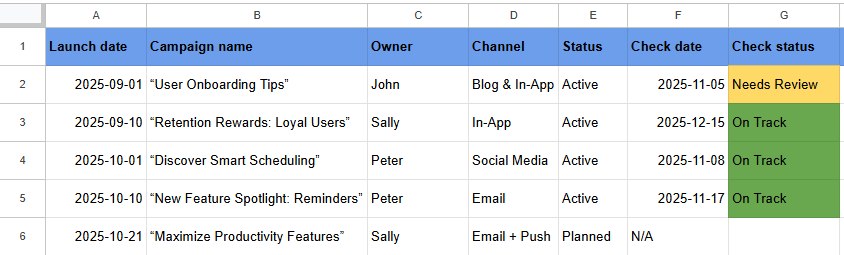
The problem with these manual processes is that they don’t scale well.
In 2025, we unfortunately find ourselves in troubling economic times. Many companies are looking for efficiency savings, resulting in shrinking team sizes and scarcer personnel resources. At the same time, products are becoming more complex. When you add in acquisition campaigns, CRM flows, website pages, and social media posts, and the workload quickly becomes overwhelming. A marketer could spend a significant part of their week reviewing old content — time that would be far better spent optimizing and improving.
Clearly, a more scalable solution is needed.
_An automated content tagging system__
In the CRM team at my current company Zenjob, we’ve addressed this challenge by building a content tagging system, which uses AI to interpret Product changes into campaign alerts.
Here’s how it works:
- Campaign tagging — Each campaign is tagged with one or more keywords summarizing the themes in the content e.g. job application, identity verification, payment process.
- Ownership tagging — Each campaign is also tagged with the responsible owner.
- Data flow — Tags are stored in our CRM tool, Braze and exported daily to Snowflake via an automated n8n workflow.
- Update feed — Our lovely Product and Engineering team maintain a feed, which centralises updates logged in Asana related to our apps, website & infrastructure.
- AI analysis — A second n8n workflow uses an LLM to analyze each product update, extract the key points, and compare them with campaign tags.
- Notifications — If a match is found, the campaign owner receives a Slack alert prompting them to review the affected content.
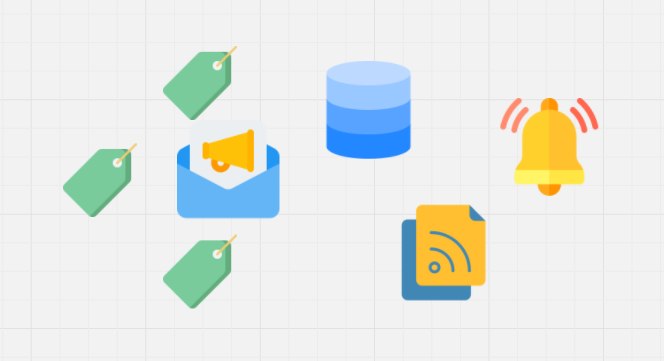
This system allows us to monitor campaigns at scale – saving team member’s time and reducing the risk of outdated or misleading content. We’ve already implemented this system in CRM and are planning to roll it out for website content too.
_…some limitations, however__
No system is perfect though, and there are some notable limitations to our automated tagging which have popped up so far.
- False positives — Sometimes feed updates trigger alerts for campaigns that aren’t actually affected, consuming unnecessary time.
- Reactive, not proactive — The system often flags changes towards the end of the development process, leaving less time to prepare marketing updates in advance.
For these reasons, automation alone struggles to solve the accuracy issue.
_Encouraging cross-departmental dialogues__
To ensure content stays on point, strong collaboration between Marketing and Product/Engineering is essential.
Accuracy improves when marketers can translate technical updates into customer-friendly language — and when PMs & engineers understand how product changes affect messaging and campaigns. Furthermore, effective copy relies on personalisation – ensuring not only that comms are strictly relevant for the end user, but also that the content is customised with behavioural data, such as ordering patterns. Getting this information into your Marketing tools also benefits from strong cross-departmental understandings. These bridges ensure that information flows smoothly and that content communicates not just what has changed, but why it matters.
In short, whilst automation can help manage scale, it’s only part of the answer. Human judgement – informed by close alignment between the Marketing and Product/Engineering teams – keeps content relevant, accurate and most importantly, effective.